Rextag U.S. Rig & Frac Crew Activity Tracker
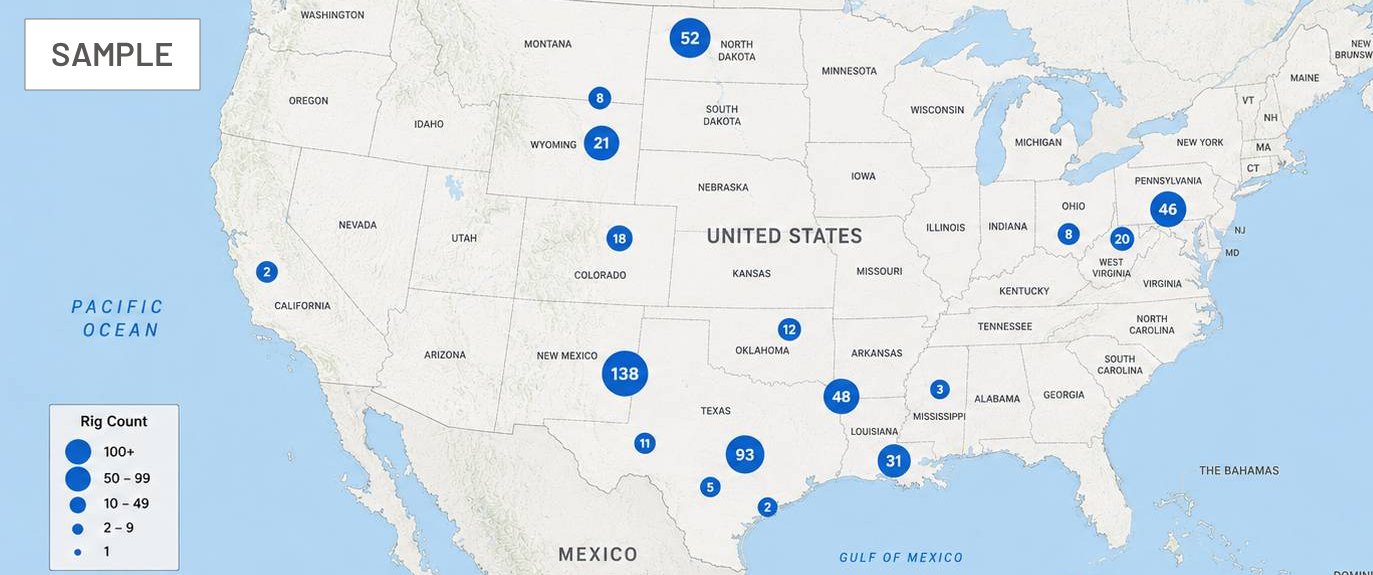
Rextag makes its weekly U.S. rig and frac crew activity data available here at no cost. This page reports active drilling and completion activity across the United States, updated weekly and browsable by state and county, giving you a clear, current view of where activity is happening across every major basin in the country.

Want to go deeper?

Subscribers to Rextag's Energy DataLink platform have access to significantly more detail. Inside Energy DataLink, you can drill down to individual well pad locations, filter activity by operator, drilling contractor, basin, and time period, and cross-reference rig and frac crew activity against Rextag's full suite of energy data, including well production reports and drilling and completion forecasts. Whether you are tracking a competitor's activity, building a prospect list, or forecasting supply in a specific play, Energy DataLink brings it all together in one place.

To learn more about Energy DataLink or to request a demo.

22e633d1-6f3b-4e02-a217-6f4612cac472_3dbc5683-4c10-4538-aa81-ae728752fc1f Pipeline Map
Rigs & Frac Crews

Rigs/Frac Crews by Rigs

Loading chart data...

Rigs/Frac Crews by Well Operators

Loading chart data...

Rigs/Frac Crews by State

Loading chart data...

Rigs/Frac Crews by County

Loading chart data...

How We Count — and Why It Matters 

Not all rig counts are created equal. The way drilling activity is measured determines how complete, how accurate, and how actionable the data is. Understanding the differences between methodologies helps explain why some counts consistently underreport activity, and why Rextag built its approach to solve that problem.

The Traditional Baker Hughes Survey Approach 

The longest-running rig count in the industry, Baker Hughes, published since 1944, is built on a network of field representatives who maintain direct contact with drilling crews and operators across their districts. A rig qualifies as active if it is physically on location and drilling, defined as "turning to the right," for at least four out of seven days in a given week. The count window begins at spud and ends at total depth.  

This approach has real strengths: it produces a consistent, long-running time series with clearly defined criteria. The fundamental limitation, however, is coverage. The data depends on voluntary communication and human reporting across a distributed network of contacts. Not every operator reports, not every survey gets returned, and not every rig in the field is captured in a given week. The result is a count that is widely acknowledged to underreport actual drilling activity, particularly among smaller operators and in less-trafficked basins. 

The GPS Tracking Approach 

Some providers have moved beyond survey-based counting by equipping rigs with proprietary GPS units, enabling daily location tracking and near-real-time activity monitoring. This is a meaningful improvement in timeliness and precision. When a rig has a GPS unit on it, its location and movement are known, and updates can be published daily rather than weekly. 

The constraint is participation. GPS coverage is limited to rigs that have been enrolled in the tracking network. Rigs operating outside that enrolled fleet are invisible to the system or must be tracked through supplemental methods. Coverage is strong where participation is strong, but gaps exist wherever hardware has not been deployed.

The Rextag Approach: SAR Satellite Imagery + AI Detection & Human Validation 

Rextag's activity tracker takes a fundamentally different approach, one that is independent of industry participation, voluntary reporting, or hardware deployment agreements. 

Our system analyzes Synthetic Aperture Radar (SAR) satellite imagery across U.S. well pad locations. SAR is a radar-based imaging technology that operates regardless of weather conditions or time of day, providing consistent coverage across the full geographic footprint of U.S. drilling activity. We apply a proprietary AI detection algorithm trained to identify the radar signatures associated with active surface equipment, specifically the large mechanical footprint generated by a drilling rig or a frac crew on location. 

Because our detection is driven by satellite observation rather than self-reporting or hardware enrollment, our coverage does not depend on who is willing to share data or who has installed a GPS unit. Every well pad in our coverage area is subject to the same detection methodology, regardless of operator, drilling contractor, or service provider. 

Comparative validation confirms that Rextag's methodology captures all activity detected by survey and GPS-based approaches, and more. We consistently identify active locations that do not appear in other published counts. 

A Note on Transparency 

At the resolution of the SAR imagery we use today, our algorithm detects significant surface mechanical activity at a well pad but cannot always distinguish between a drilling rig and a frac crew. Both generate a detectable radar signature. As a result, our reported count reflects combined drilling and completion activity and will run modestly higher than a pure drilling-only count. 

Every location in our count has been reviewed and confirmed by a member of our team before publication. We do not publish algorithmically flagged locations without human sign-off. 

The practical implication: Rextag's count is likely to be slightly above a pure drilling-only count than to miss active locations. We may include some frac crews alongside drilling rigs. We are very unlikely to miss either. For customers who need confidence that no significant activity is going undetected, that is the right trade-off.

Baker Hughes  GPS-Based Providers  Rextag 

Detection method

Field rep network / surveys

Proprietary GPS hardware

SAR satellite + AI& Human Validation

Coverage

Enrolled contacts only

GPS-equipped rigs only

All well pads, all operators

Update frequency

Weekly

Daily

Weekly

Known limitation

Undercounting

Enrollment gaps

Rig vs Frac not distinguished